
On this page
- Step 1: Check the basement floor
- Step 2: Look for a gauge
- Step 3: Follow the pipe up
- Step 4: Look for an outlet or junction box
- Step 5: Check the roof and outside walls
- How to tell a radon pipe from a plumbing vent
- Other places to check
- What to do if you find a passive pipe
- Key takeaways
- Frequently Asked Questions
- Found a passive pipe?
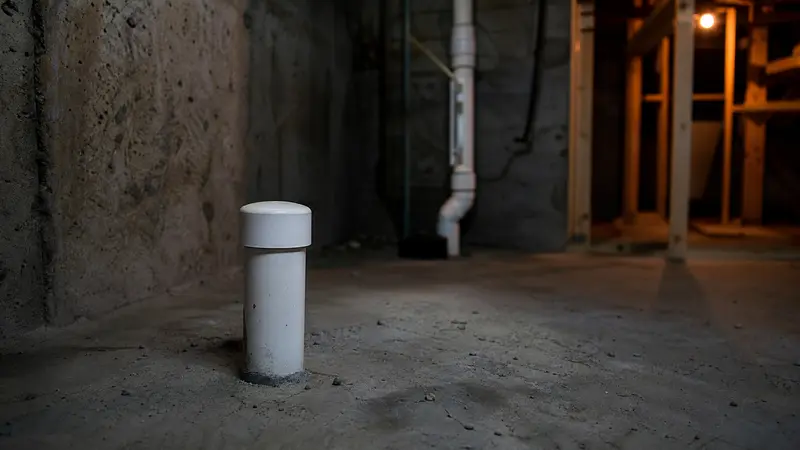
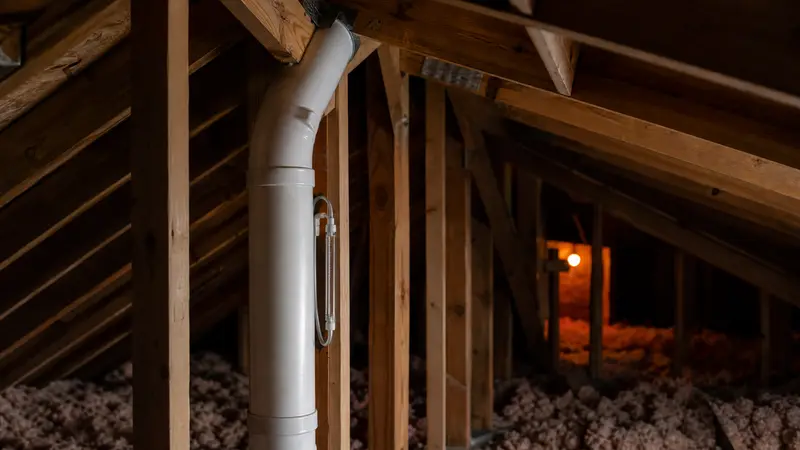
To tell if your house has a radon pipe, look for a 3 or 4 inch PVC pipe that comes up through the basement floor, often in a utility room or closet and often labeled "radon." Follow it up to the attic, where it should run out through the roof. An outlet or electrical box near the pipe in the attic is another strong clue, since that is where a fan is wired in for passive radon system activation.
Step 1: Check the basement floor
Start in the lowest level of the house. A radon pipe begins under the slab, so look for a pipe that goes straight down into the concrete floor.
Common spots:
- A utility or mechanical room.
- A closet or storage area.
- Near the sump pit.
- In a corner behind the furnace or water heater.
The pipe is usually white or gray PVC, 3 or 4 inches across. It may have a label that says "radon," "radon vent" or "radon reduction system."
Step 2: Look for a gauge
Active systems have a manometer, a small U-shaped tube with colored liquid, mounted on the pipe. If you see one, you have an active system or one that once had a fan.
Passive systems usually have no gauge. If the pipe has no gauge and no fan anywhere along it, it may be a passive stack.
Step 3: Follow the pipe up
Trace the pipe from the basement through the house. It often runs inside a wall, a closet chase or a utility shaft. You may lose sight of it on the main floors.
Then check the attic. Look for the same size pipe coming up through the attic floor and going out through the roof. If there is a fan in the pipe, the system is active. If the pipe runs straight to the roof with no fan, it is likely passive.
Step 4: Look for an outlet or junction box
Builders who install passive systems often add an electrical box near the pipe in the attic so a fan can be added later. EPA's guide for new home buyers mentions this as a standard part of radon-resistant construction. An outlet or capped box next to the pipe is a good sign you have a passive system ready for a fan.
Step 5: Check the roof and outside walls
From outside, look for a pipe sticking up above the roof that is wider than typical plumbing vents. Some active systems run the pipe up the outside wall instead, with the fan mounted outside.
How to tell a radon pipe from a plumbing vent
| Clue | Radon pipe | Plumbing vent |
|---|---|---|
| Where it starts | Goes into the basement slab | Connects to drain lines and fixtures |
| Label | Often says "radon" | Usually unlabeled |
| Gauge | May have a U-tube manometer | Never |
| Size | Usually 3 or 4 inch | Varies, often smaller |
| Fan | In attic or outside, if active | None |
If you are unsure, do not cut into the pipe or take it apart.
Other places to check
- Home inspection report. Inspectors often note radon pipes.
- Builder paperwork. New-home documents may list radon-resistant features.
- Your seller's disclosure. Sellers may list a radon system or past test results.
What to do if you find a passive pipe
Test your home for radon. A passive pipe does not mean your levels are low. EPA advises testing every new home soon after move-in, even if it was built radon-resistant. If your result is 4.0 pCi/L or higher, a fan can be added. Learn more about what a passive radon system is and how it works.
York County is in EPA Radon Zone 1. For testing basics, see the EPA Citizen's Guide to Radon.
Key takeaways
- Look for a 3 or 4 inch PVC pipe going into the basement slab.
- Check for a "radon" label and a U-tube gauge.
- Follow the pipe to the attic and roof.
- An outlet near the attic pipe often means a passive system ready for a fan.
- Test your home either way.
Frequently Asked Questions
Can a radon pipe be hidden in a wall?
Yes. Builders often run it through a wall or chase, so you may only see it in the basement and attic.
What if the pipe stops in the attic?
A pipe that ends in the attic without reaching the roof is not complete. Have a certified mitigator look at it.
Does a radon pipe affect resale?
A labeled system shows buyers the home was built with radon in mind. Test results matter most.
Found a passive pipe?
If you have a passive stack and a high test, we can add the fan. Call (717) 356-3035 any time for a same-day callback.