
On this page
A passive radon system is a pipe that a builder installs from the gravel under the basement slab, up through the house, and out the roof, with no fan. It relies on natural draft, as warm air rises in the pipe, to carry some soil gas outside. It is built so a fan can be added later if a radon test comes back high, a step called passive radon activation.
How a passive radon system is built
Passive systems are part of what EPA calls radon-resistant new construction (RRNC). The parts usually include:
- A gas-permeable layer. A layer of clean gravel (or a special mat) under the slab lets soil gas move freely to the pipe.
- Plastic sheeting. A vapor barrier on top of the gravel helps keep soil gas from coming up through the slab.
- Sealing. Builders seal cracks, joints and openings in the foundation.
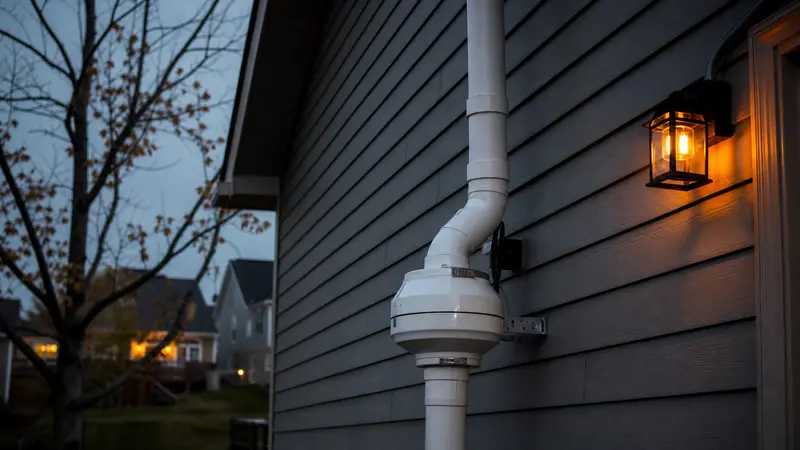
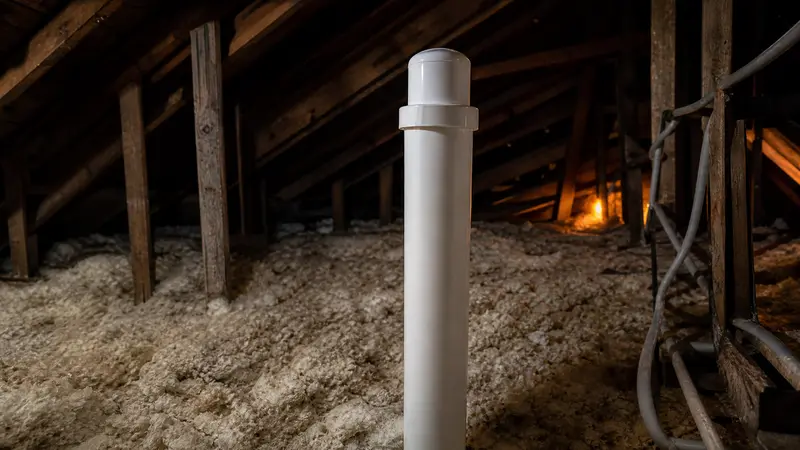
- A vent pipe. A 3 or 4 inch PVC pipe runs from the gravel layer, up through the house, and out above the roof.
- An electrical box in the attic. EPA's guide for new home buyers notes that an electrical junction box is included in the attic to make adding a fan easier.
The pipe is often labeled so future owners and contractors know what it is.
How it works without a fan
A passive system depends on the stack effect. Air in the pipe is warmed as it passes through the heated house. Warm air rises, so it creates a weak draft that pulls some soil gas up and out.
This works best in cold weather, when the difference between indoor and outdoor temperature is largest. In mild weather, the draft is weaker. Wind can also help or hurt.
Does a passive system lower radon enough?
Sometimes. EPA says passive radon-resistant techniques "can help to reduce radon levels" when installed properly and completely. But EPA also notes that passive sub-slab suction is "generally not as effective in reducing high radon levels as active subslab suction."
That is why EPA says every new home should be tested soon after move-in, even if it was built radon-resistant. To see how passive and fan-driven systems compare, read passive vs. active radon systems.
When should the fan be added to a new home's system?
Test first, then decide. EPA advises testing every new home as soon as possible after you move in. If your result is 4.0 pCi/L or higher, EPA says a vent fan can easily be added to make the system active and lower radon further. If your result is between 2 and 4 pCi/L, EPA says to consider fixing it.
A few more timing points:
- After move-in, not before. The house needs to be occupied with normal heating and cooling for a test to reflect real conditions.
- Retest if you start using the basement. EPA advises retesting on a lower level if you begin living there.
- Test again every two years even if your first result was low.
The fan should go in the attic or outside the house, never in a basement or other living space. After the fan is added, a clearance test confirms it worked.
Passive systems in Pennsylvania
PA DEP states that Pennsylvania's statewide building code does not require radon-resistant new construction, though some municipalities may adopt it. See the PA DEP page on radon-resistant new construction. Some builders include a passive stack anyway, especially in high-radon areas like York County, which sits in EPA Radon Zone 1.
PA DEP also notes that installing a system during construction should cost less than adding one later, and that if high levels are found after move-in, "a fan can be readily installed."
Builders and developers can learn more on our page on new construction radon services in York.
Passive system limits
Passive systems have a few weak spots:
- Weak, changing draft. Natural draft depends on the weather.
- No warning device. Without a fan, there is usually no gauge or alarm to tell you whether it is working.
- Hidden gaps. If the gravel layer, barrier or sealing was not completed, the system may not pull from enough soil.
- Changes over time. Settling cracks and new slab openings can weaken it.
Key takeaways
- A passive radon system is a pipe from under the slab to the roof, with no fan.
- It relies on natural draft from warm air rising in the pipe.
- EPA says passive suction is generally less effective than active suction.
- Test every new home soon after move-in, even with a passive system.
- If you test at 4.0 pCi/L or higher, a fan can be added to make it active.
Frequently Asked Questions
Is a passive radon pipe the same as a plumbing vent?
No. A radon pipe starts under the slab and carries soil gas. A plumbing vent connects to drain lines. A radon pipe is often labeled and is not tied into any drains.
Can a passive system make radon worse?
It is not designed to. If it is incomplete or damaged, it may simply do little. A test tells you where you stand.
Do older York homes have passive systems?
Usually not. Passive stacks are mostly found in newer construction. Older homes that need mitigation typically get a full active system.
Have a passive pipe and a high test?
If your home has a passive stack and your radon test came back high, we can add the fan. Call (717) 356-3035 any time for a same-day callback.