On this page
Whether it comes from a home kit or a certified radon test, your radon result is reported in picocuries per liter (pCi/L). At 4.0 pCi/L or higher, you are at or above the EPA action level, and the EPA recommends fixing your home. Between 2 and 4 pCi/L, the EPA says to consider fixing, because no radon level is risk-free. Below 2, your risk is lower, but retesting over time still makes sense.
What "pCi/L" means
A picocurie is a tiny unit of radioactivity. "Picocuries per liter" tells you how much radioactive decay from radon is happening in each liter of air. The higher the number, the more radiation your lungs are exposed to over time.
For context, the EPA's Citizen's Guide to Radon estimates the average indoor radon level in U.S. homes is about 1.3 pCi/L. Outdoor air averages about 0.4 pCi/L.
Other units you may see
- Bq/m³ (becquerels per cubic meter). Used in Canada, Europe and by many digital monitors. 1 pCi/L equals 37 Bq/m³, so 4.0 pCi/L is about 148 Bq/m³.
- WL (working levels). Some reports measure radon decay products instead of radon gas. Labs usually convert this for you. If your report shows WL, ask the tester to explain the pCi/L equivalent.
The key thresholds
| Result | What it means | What the EPA says |
|---|---|---|
| 4.0 pCi/L or higher | At or above the action level | Fix the home (after confirming with a follow-up test, if this was a first short-term test) |
| 2.0 to 3.9 pCi/L | Below the action level, but not risk-free | Consider fixing |
| Below 2.0 pCi/L | Lower risk | Retest after major home changes and periodically |
Why 4.0 pCi/L?
The EPA set 4.0 pCi/L as the level where it recommends action. It is not a "safe" line. It reflects both the health risk and what mitigation systems can reliably achieve. The EPA notes that radon levels in most homes can be reduced to 2 pCi/L or below.
Why the 2 to 4 range matters
Radon risk rises with exposure. A home at 3.5 pCi/L carries more risk than a home at 1.0, even though both are under the action level. That is why the EPA tells homeowners in this range to consider fixing. The World Health Organization uses a reference level of 100 Bq/m³, which is about 2.7 pCi/L, so some homes that pass the U.S. line would be above the WHO level.
How to read a professional test report
If a certified tester used a continuous radon monitor, your report will have more than one number. Here is what to look for.
The average
This is the main result. It is the average of all hourly readings over the test period. It is the number used in a home sale and to decide on mitigation.
The hourly graph
The graph shows radon rising and falling over the test. A pattern that climbs at night and dips during the day is normal. A sudden drop to near zero for several hours can be a sign a window or door was opened. A steady line across the whole test is a good sign the test ran under proper conditions.
Test conditions
Most reports list the start and end times, test location, device serial number and calibration date. Many also list temperature, humidity and barometric pressure. Some note motion or power interruptions.
The tester's certification
In Pennsylvania, a test done for someone else must be run by a PA DEP-certified tester. The report should show that certification.
What to do next, by result
Your result is 4.0 pCi/L or higher
If this was your first short-term test, the EPA recommends a follow-up test. If the first result was more than twice the action level, follow up with another short-term test right away. If the follow-up confirms 4.0 or higher, plan to fix the home. In a home sale, a single certified short-term test is usually what the contract relies on.
A mitigation system, most often sub-slab depressurization, pulls radon from under the slab and vents it above the roof. After the install, a clearance test confirms the level dropped.
Your result is between 2 and 4 pCi/L
Consider a long-term test to see your yearly average. If it holds in this range, talk with a certified mitigator about whether a system makes sense for your home and budget.
Your result is below 2 pCi/L
Your current risk is lower. Retest if you finish the basement, make major changes to the foundation or HVAC, or move a bedroom to a lower floor. Radon levels can change over time.
Why your number might not match another test
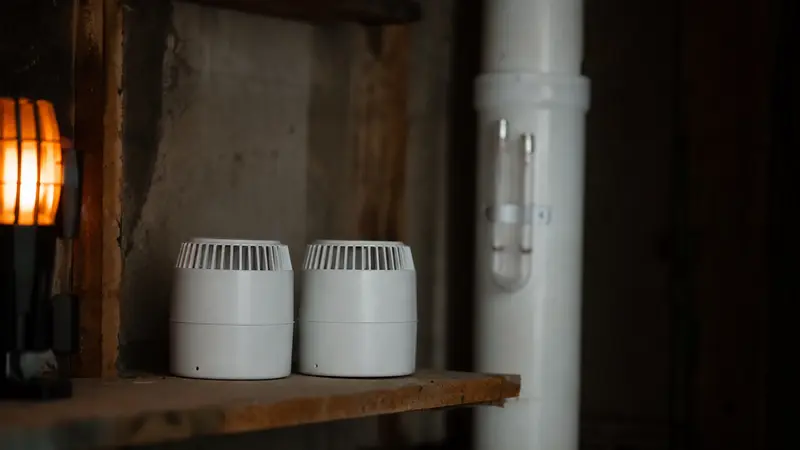
Two tests in the same house can give different numbers. Weather, season, placement and device type all play a role. A consumer digital monitor sitting next to a professional test may also read differently over a few days. If you rely on a home device, see our guide: are digital radon monitors accurate.
Results in York homes
York County is in EPA Radon Zone 1, the highest potential category. PA DEP reports that about 40% of homes tested in Pennsylvania come back above 4.0 pCi/L. A high result here is common and fixable. It does not mean something is wrong with your house; it means the ground under it gives off radon, as much of this region does.
Key takeaways
- Results are in pCi/L; 1 pCi/L equals 37 Bq/m³.
- 4.0 pCi/L or higher: the EPA recommends fixing the home.
- 2 to 4 pCi/L: the EPA says consider fixing.
- Below 2: lower risk, but retest after big changes.
- On a professional report, read the average, the hourly graph and the test conditions.
- Confirm a high first short-term result with a follow-up test.
Frequently Asked Questions
Is 3 pCi/L safe?
No level of radon is risk-free. At 3 pCi/L, the EPA says to consider fixing, and the WHO reference level is about 2.7 pCi/L.
Can radon levels go down on their own?
Levels swing with weather and season, but the source under your home does not go away. Lasting reduction takes a mitigation system.
Do I need to retest after mitigation?
Yes. A clearance test should run no sooner than 24 hours after the system starts and within 30 days. The EPA then recommends retesting every two years.
Get a clear answer
If you want a certified number with hourly data and a plain-English explanation, book radon testing in York, PA. Call (717) 356-3035 any time for a same-day callback.