
On this page
Yes. Slab-on-grade and crawl space homes sit on soil too, and radon comes from the soil. EPA says any home can have a radon problem, with or without a basement. In York County's PA DEP radon test data, more than a third of slab and crawl space tests reached 4.0 pCi/L or higher, so these homes need testing too.
Why basements get the attention
Basements are dug into the ground, surrounded by soil on the floor and walls. That gives radon a lot of contact area and many entry points. So basements often test highest, and most radon advice focuses on them.
But radon doesn't need a basement. It needs a path from the soil into the house. Every home has that path in some form.
How radon gets into slab homes
A slab-on-grade home sits on a concrete floor poured right on the ground. Radon can enter through:
- Cracks in the slab
- Control joints and the edge where the slab meets the footing
- Gaps around plumbing that comes up through the floor
- Openings under tubs and showers
- Hollow block stem walls
Because living space sits right on the slab, there's no basement to act as a buffer. You're living at the lowest level.
How radon gets into crawl space homes
Crawl space homes have a short space between the soil and the first floor. Many have bare dirt or a thin plastic sheet on the ground. Radon flows up from the soil, fills the crawl space and then moves into the home through:
- Gaps around pipes, ducts and wires in the floor
- Air pulled up by the stack effect
- Ductwork or an air handler running in the crawl space
- Open connections to a basement section
A vented crawl space can lower radon somewhat, but it doesn't solve the problem in every home, and it can cause other issues like cold floors and moisture.
What the York County data shows
PA DEP test records for York County let us compare results by test location.
| Test location | Average (pCi/L) | % at or above 4.0 pCi/L |
|---|---|---|
| Basement | 11.8 | 56% |
| Crawl space | 7.5 | 39% |
| Slab on grade | 6.3 | 37% |
| First floor | 5.8 | 33% |
Basements read highest, as expected. But slab and crawl space results are far from low. Roughly one in three of those tests crossed EPA's action level. (The crawl space sample is small, about 130 tests, so treat that row with care.)
Mixed foundations are common in York
Many York homes combine foundation types. A house might have a basement under the original section, a crawl space under a later addition and a slab under a sunroom or garage room. Each part can let radon in, and a mitigation system may need to address more than one area.
How radon is fixed without a basement
EPA describes soil suction methods for both slab and crawl space homes (EPA radon information).
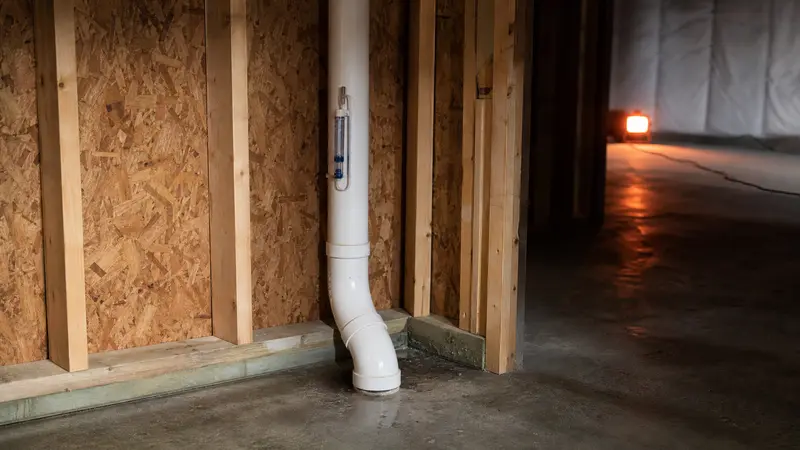
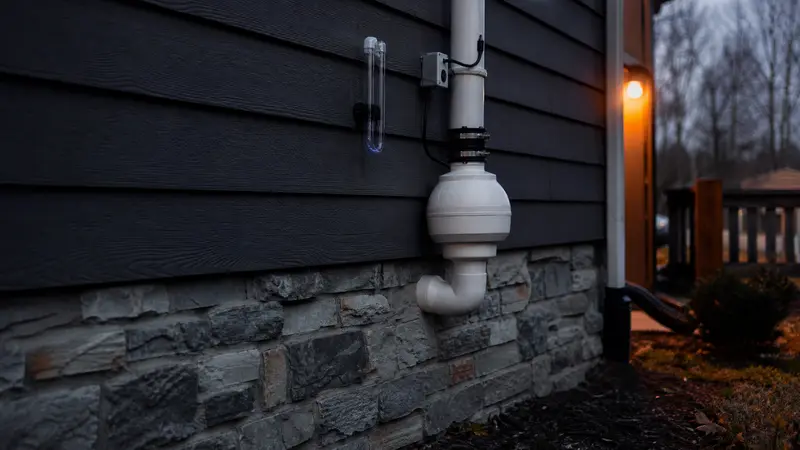
Slab homes. Sub-slab depressurization works here too. A suction point goes through the slab, and a fan pulls soil gas from underneath and vents it above the roof. The pipe can run inside through a closet or outside along a wall. Some homes use a suction point through the side of the stem wall.
Crawl space homes. The usual fix is sub-membrane depressurization. A durable plastic membrane covers the crawl space floor and is sealed at the walls and piers. A fan pulls radon from under the membrane and vents it outside. EPA calls this the most effective way to lower radon in crawl space homes.
In both cases, a clearance test afterward confirms the result.
When to test a home without a basement
Test the lowest lived-in level, which in a slab home is the main floor. For crawl space homes, test the lowest lived-in floor, not the crawl space itself.
Winter is a good time to test because homes are closed up and levels tend to run higher. It's also when January is National Radon Action Month, a yearly reminder from EPA to test.
Key takeaways
- Homes without basements can still have high radon.
- York County PA DEP data shows more than a third of slab and crawl space tests at or above 4.0 pCi/L.
- Slab homes use sub-slab depressurization. Crawl space homes use a sealed membrane with suction.
- Test the lowest lived-in level.
Frequently Asked Questions
Is a slab home lower risk than a basement home?
On average, slab tests in York County read lower than basement tests. But averages don't protect any one home. Many slab homes test high.
Does encapsulating my crawl space fix radon?
Encapsulation alone may lower radon some, but it isn't designed for it. Adding suction under the membrane is what makes it a radon system.
See local radon data
Check how your area compares on our York County radon levels page, built from PA DEP test data. For a test or a free written quote, call (717) 356-3035 any time.