On this page
Commercial radon mitigation cost depends on the building's footprint, how the slab is divided, how many fans are needed, and how much testing is required. There is no reliable flat rate. Our commercial pricing starts at $2,500 and every project is priced with a free written quote after a site visit and diagnostic testing.
How much does commercial radon mitigation cost?
A single-family home usually needs one fan and one or two suction points. A commercial building may need several systems, each with its own fan, pipe and suction points. That is why commercial prices scale with the building, not with a set package.
Here is how the common building types compare:
| Building type | Usual approach | Main cost drivers | Our price |
|---|---|---|---|
| Small office or retail | Sub-slab depressurization, 1 to 3 fans | Footprint, finished floors, roof access | $935 to $1,320 |
| Multifamily (apartments, condos) | One or more systems per building or unit stack | Number of ground-contact units, testing every unit | $935 to $1,320 |
| Warehouse or light industrial | Sub-slab, larger fans | Slab size, footings that divide the slab | $935 to $1,320 |
| Schools, daycares, churches | Multiple systems, sometimes HVAC changes | Many rooms in ground contact, schedules | $935 to $1,320 |
| Mixed-use with basement | Sub-slab and sometimes sump or wall suction | Mixed foundations, tenant access | $935 to $1,320 |
What drives the price
Footprint and slab layout
Interior footings, grade beams and thickened slabs can split the area under a building into separate sections. Each section may need its own suction point. A pre-installation diagnostic, called a pressure field extension test, tells us how far suction travels under the slab.
Number of fans and pipe runs
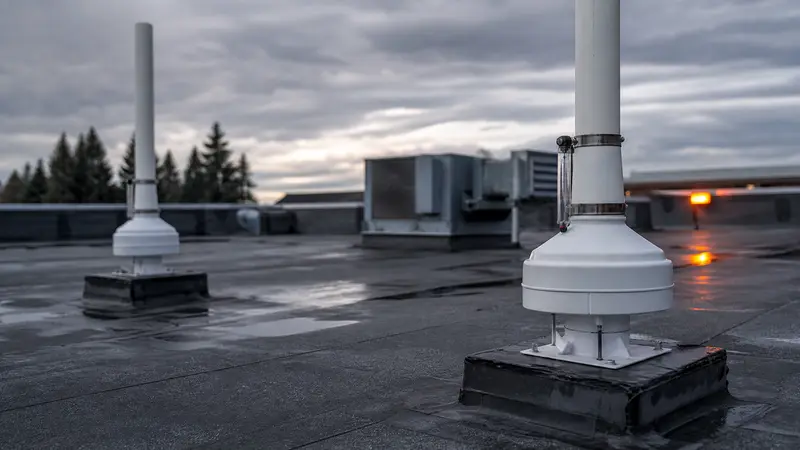
Larger buildings often need several fans. Each one needs pipe to the roof, power and a manometer. Long horizontal runs through drop ceilings add labor.
Testing scope
Commercial and multifamily testing is more involved than a house. Standards call for testing more rooms in ground contact. That pre-mitigation testing, and the post-mitigation testing that follows, is part of the price.
Building systems
In some buildings, the HVAC system affects radon by pulling or pushing air. Balancing ventilation, or adding fresh air, can be part of the solution. That may involve an HVAC contractor.
Access and scheduling
Work after hours, on weekends, or around tenants and students adds cost. Roof access, permits and lift rental can also add to the total.
Standards and paperwork
Large buildings and multifamily properties are covered by their own ANSI/AARST standards, separate from the single-family standard. Following them means more design work and documentation. The EPA radon standards of practice page lists the current standards.
Who needs commercial mitigation
- Landlords and property managers with ground-floor units or basements.
- Business owners who want to protect staff and customers.
- Schools and daycares, where children spend many hours in ground-level rooms. Pennsylvania does not currently require radon testing in schools or daycares, though bills to require school testing are pending.
- Buyers and lenders in commercial or multifamily deals that include environmental due diligence.
York County is in EPA Radon Zone 1, the highest radon potential category. Any York building with ground contact should be tested.
Wells serving commercial buildings
Some rural York County businesses and small multifamily buildings use private wells. Radon in well water is treated with a separate system at the water supply. Our guide on radon in water treatment cost covers how those systems are priced.
How to get an accurate commercial quote
- Share building plans if you have them. Foundation drawings save time.
- Share existing radon test data. Room-by-room results help us target the work.
- Allow a diagnostic visit. We check slab communication and plan suction points.
- Ask for a written scope. It should list the number of systems, fan models, pipe routes, testing plan and clearance criteria.
- Ask about the clearance guarantee. Our written guarantee covers the post-install test result: below 4.0 pCi/L or we keep working at no charge.
Pennsylvania requires PA DEP certification for anyone who tests or mitigates radon for others, including in commercial buildings. Our team holds that certification. Our page on commercial radon mitigation in York explains how we handle offices, rentals and multifamily buildings.
Key takeaways
- Commercial radon mitigation is priced per project, not with a flat rate.
- Footprint, slab layout, fan count and testing scope drive the price.
- Our commercial pricing starts at $2,500.
- Large buildings and multifamily properties follow their own ANSI/AARST standards.
- Get a written scope that lists every system and the testing plan.
Frequently Asked Questions
How long does a commercial install take?
Small buildings can often be done in a day or two. Larger buildings or multifamily properties may take several days, depending on access and the number of systems.
Can work happen while the business is open?
Usually yes. Coring and drilling make noise and some dust, so many owners schedule that part after hours.
Do I need to test every unit in an apartment building?
Standards for multifamily buildings call for testing all ground-contact units and a share of upper units. Your tester will explain the plan for your building.
Next step
To see how commercial jobs compare with residential pricing, read our guide to radon mitigation cost in York. Call (717) 356-3035 any time for a same-day callback and a free written quote.