
On this page
- How hollow block walls move radon
- Why a standard slab system may not be enough
- Block wall depressurization
- Sealing the top course: why it matters
- Finished basements with block walls
- Block walls and moisture
- Block wall basements in York
- Key takeaways
- Frequently Asked Questions
- Get help with a block wall basement
Block wall basements need special treatment because hollow concrete blocks have open cores that carry soil gas up inside the wall. Radon then leaks out through cracks, holes and the open top course. Block wall radon mitigation adds suction to those cores, or seals them, so the system catches gas in the walls as well as under the floor. This is a common part of radon mitigation for older foundations.
How hollow block walls move radon
A concrete masonry unit (the gray block most people call cinder block) has two or three hollow cells inside. When blocks are stacked in a wall, those cells line up into vertical channels that run from the footing to the top of the wall.
Soil gas presses against the outside of the wall below grade. Block is porous, and mortar joints crack over time, so gas seeps into the hollow cores. Once inside, it has an open path. It can rise to the top of the wall, move sideways between connected cores and come out anywhere the wall has an opening.
Common exit points include:
- The open top course. In many homes the top row of block was never capped, so the cores open right under the sill plate.
- Holes for pipes, wires and old fixtures. Every hole in a block face opens one or more cores to the room.
- Cracked or missing mortar joints.
- The gap at the bottom. Block walls often sit on a footing with a joint where the slab meets the wall.
The block wall acts like a set of small chimneys, and the stack effect in winter makes it worse. Warm air rising in the house lowers the pressure in the basement and pulls more gas into the cores.
Why a standard slab system may not be enough
Sub-slab depressurization puts a fan on a pipe under the floor. On many block-wall homes that works well, because the suction under the slab also draws on the bottom of the cores and pulls gas from them.
On others, it falls short. If the slab sits on packed soil with little gravel, or if the cores are blocked by mortar droppings at the bottom, the suction does not reach the wall. Gas in the cores keeps rising and leaking out the top. The floor gets fixed but the walls do not.
Block wall depressurization
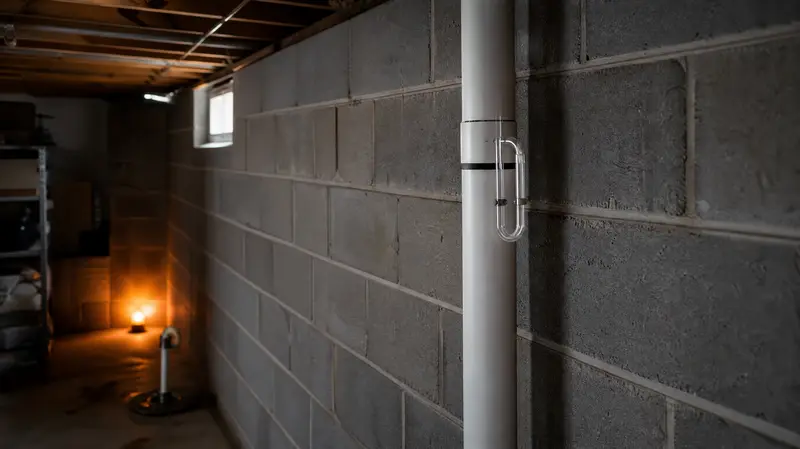
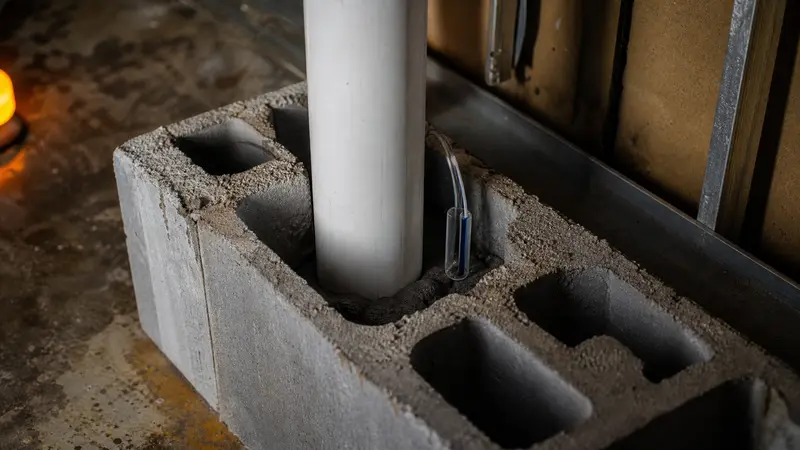
Block wall depressurization (BWD) applies suction to the hollow cores themselves. A suction point is drilled into the block, and the fan pulls gas out of the cores before it can leak into the basement.
For this to work, the wall has to be fairly tight. Otherwise the fan just pulls basement air in through every open hole. So BWD almost always goes with sealing:
- Seal the top course. Open cores at the top of the wall are closed with foam, mortar or a cap so the fan is not pulling attic and basement air.
- Seal openings in the block face. Pipe holes, broken blocks and wide cracks get filled.
- Seal the wall-floor joint. This stops the vacuum from leaking at the bottom.
- Add one or more suction points. Points may go into the block, under the slab, or both, all tied into one fan.
Installers often combine BWD with sub-slab suction. The slab points handle the floor, and the wall points handle the cores. Diagnostic testing helps decide where to put each one.
Sealing the top course: why it matters
The top course deserves its own attention. If it is open, the cores are connected to the space under the floor framing, and gas rises straight into the first floor's wall cavities and the basement air. Sealing it is often one of the most effective single steps on a block-wall home. It is also a step that is easy to skip, because the top of the wall is hidden behind the sill and band joist and can be hard to reach.
Finished basements with block walls
If your block walls are covered with drywall or paneling, the installer may not be able to see or seal every hole. That does not rule out a good system. It means:
- Sub-slab suction becomes more important, since wall access is limited.
- Wall suction points may be placed in a utility room or unfinished corner.
- Some sealing can be done from accessible areas, such as the top course in the basement ceiling.
Block walls and moisture
Block walls often show damp spots, white mineral deposits or water at the base after heavy rain. Some homes have a drain channel or weep holes at the bottom of the wall. A radon design has to keep water moving. Weep holes cannot simply be sealed shut without a plan, and drain channels may need to be tied into the system or sealed with covers that still let water pass.
Block walls also sometimes sit next to areas with no slab at all. If your basement has an old dirt section or a crawl space under an addition, see our guide on radon in a dirt-floor basement.
Block wall basements in York
Many mid-century homes in the suburbs around York were built with hollow block basement walls. Older homes in the city more often have fieldstone, which leaks in a different way. York County is in EPA Radon Zone 1, so block-wall homes here should be tested, ideally with the test placed in the lowest lived-in level.
The EPA Consumer's Guide to Radon Reduction describes block-wall suction as one of the standard soil depressurization methods. In Pennsylvania, any contractor who installs it for you must be certified by PA DEP.
Key takeaways
- Hollow block cores act as channels that carry radon up and out of the wall.
- The open top course is a common and often-missed leak.
- Block wall depressurization pulls gas from the cores, but it needs sealing to work.
- Many systems combine wall and slab suction points on one fan.
- Water management has to be part of the design, so drains and weep holes still work.
Frequently Asked Questions
Can I just paint my block walls with sealer?
Waterproof paint or sealer may slow moisture, but it does not stop radon. Gas still moves through the cores and out of unsealed openings.
How do I know if my top course is open?
Look at the top of the basement wall where it meets the wood sill. If you can see open holes in the blocks, the cores are open.
Does a block wall system cost more?
Often a little, because of the extra sealing and possible wall suction points. The written quote should list that work.
Get help with a block wall basement
If your block-wall basement tested high, a site visit will show whether slab suction is enough or whether the walls need their own treatment. Call (717) 356-3035 any time for a same-day callback.